Real advice from a Deaf Awareness Trainer on confidence, communication, and navigating hearing loss at work

One of the most valuable parts of Deaf Awareness Training often happens after the session ends, and it is the honest conversations people finally feel comfortable having.
After a Deaf Awareness session delivered by our trainer Abi for the Royal Horticultural Society (RHS), one attendee reached out privately with a few thoughtful questions about navigating hearing loss in work and social situations.
Questions many people quietly wonder about, but are often too nervous to ask.
We wanted to share some of her answers because they offer such a realistic and reassuring insight into life with hearing loss, confidence, self-advocacy, and workplace communication.

“I noticed Abi was very good at flagging when she couldn’t hear.”
One of the first things one of the staff from RHS noticed during the training was how confidently Abi would tell people when she had missed something or needed repetition.
For many people with hearing loss, this can actually be one of the hardest skills to develop.
Abi explained that confidence did not appear overnight.
“In a work situation, I will usually flag to people if I miss something. It took me a while to develop the confidence to do so though.”
That sentence will probably resonate with a lot of people.
Many people with hearing loss spend years pretending they heard something properly, nodding along, or staying quiet because they worry about seeming difficult, awkward, or disruptive.
Over time, Abi realised something important: most people are actually happy to repeat themselves when they understand the situation.
“I usually find that when I do, people have no problem repeating what they said. They often apologise and I tend to reassure them that it’s OK and that everyone forgets sometimes.”
There is something really powerful in that response: Just calm honesty.
Abi also shared that she often reassures people so they do not feel told off or uncomfortable, because negative reactions can sometimes make people avoid communicating altogether afterwards.
That level of emotional awareness is something many people with hearing loss develop constantly without even realising it.
“Sorry, I missed that.”

One of the most relatable parts of Abi’s response was her honesty about social situations.
Work meetings can already feel tiring enough, but restaurants, coffee shops, lunch breaks, and group conversations are often where many people struggle most.
Abi admitted that large groups can absolutely be difficult.
In work settings, she manages this by positioning herself carefully, using her hearing equipment, and reminding people to take turns speaking where possible.
But socially, things can feel harder because you are not controlling the environment.
Still, she explained that she will often interrupt and simply say:
“Sorry, I missed that.”
And when somebody replies with:
“Oh, it’s not important.”
Abi’s response is brilliant:
“I’d really like to know!”
People with hearing loss are often unintentionally excluded from small conversations, side comments, jokes, or quick exchanges. Over time, constantly missing these moments can become exhausting and isolating. For many Deaf people, this experience is often referred to as ‘Dinner Table Syndrome’, where conversations continue around you while access quietly disappears. You can read more about that here: Dinner Table Syndrome blog post.
That simple response reminds people that access is not only about important information. It is also about connection.
The hearing equipment Abi uses every day
Another question asked was about the hearing equipment Abi used during training.
Abi uses the Phonak Roger On system alongside her Phonak hearing aids. Depending on the hearing aids someone has, different versions and setups are available.
What was particularly interesting was hearing how often Abi uses the equipment outside formal work settings too.
Meetings, training sessions, restaurants, coffee shops, social gatherings...
“If I’m in a noisy restaurant or café with one person, I will get them to wear the microphone so their voice is closer to the microphone than the background noise.”
This is something many hearing people never really think about: background noise can completely change someone’s ability to follow conversation.
Abi also openly acknowledged something important that often gets forgotten in conversations about hearing technology: even with equipment, hearing loss is still tiring.
The equipment helps enormously, but it is not magic.
“There will still be times when I miss things, especially when I am tired.”
Many people assume hearing aids or assistive technology “fix” hearing loss completely, when in reality they simply help reduce some of the barriers.

The confidence to remind people
One of the strongest messages throughout Abi’s replies was the importance of gentle self-advocacy.
Not every person with hearing loss feels comfortable disclosing it openly, and not everyone wants to wear badges or explain themselves constantly, and that is understandable.
Abi shared that she sometimes wears a badge saying:
“I have hearing loss, please speak clearly.”
For some people, that visibility feels empowering. For others, it may feel uncomfortable.
There is no single correct way to navigate hearing loss, but Abi explained that what helped her most was recognising she had the right to full access to information at work.
Access is not asking for special treatment. It is asking to participate equally.
Why Deaf Awareness still matters so much
One thing that stood out strongly throughout this conversation was how much easier communication becomes when people already understand Deaf awareness basics.
The confidence to ask for repetition.
The willingness to clarify.
The understanding around group conversations.
The patience during communication breakdowns.
All of this improves massively when workplaces and teams have better awareness in the first place.
The reality is that many people with hearing loss spend huge amounts of energy managing communication quietly behind the scenes every single day.
Sometimes, the most supportive thing a workplace can offer is simply understanding.
At Deaf Umbrella, these are exactly the kinds of honest conversations we love creating through our Deaf Awareness Training sessions. The goal is never perfection. It is helping people feel more confident, informed, and comfortable communicating openly.
And sometimes the questions asked after the training are the ones that stay with people the longest.
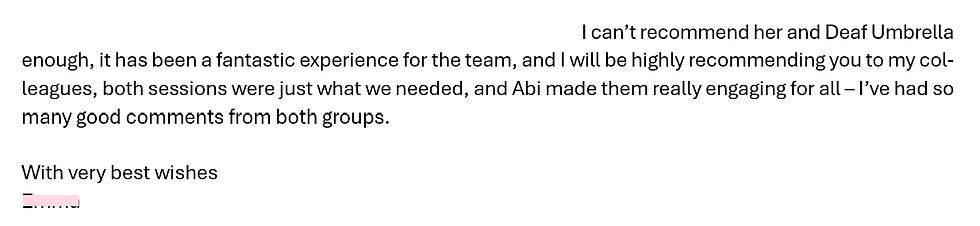
Here are just a few of the reflections and feedback shared by attendees after Deaf Awareness Training sessions delivered by Abi, highlighting the real impact that honest conversations can have within workplaces: