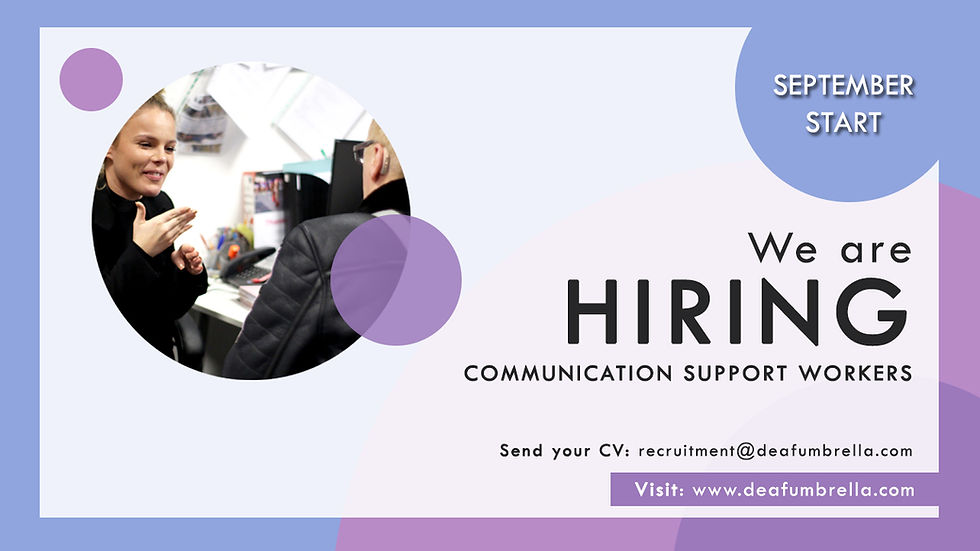
Looking for CSW work this September? Learn why working with an agency might be the right step

There’s a point many Communication Support Workers (CSWs) reach, especially around this time of year.
✔︎ You’ve got your BSL.
✔︎ You’ve done some work, or you’re ready to start.
September is coming, and you’re thinking… what’s the best way to move forward?
For some, it’s going directly into freelance work. For others, it’s applying to colleges or workplaces independently. And for many, it’s working with an agency.
But not everyone fully understands what that actually means in practice, or how it can shape your experience as a CSW.
A good agency does much more than find you work. It gives you someone to turn to when things don't go to plan, helps you grow professionally, and reminds you that you're not dealing with difficult situations on your own.

If you’re new to the role or still building confidence, this is where the right environment really matters.
One thing is to have the qualification. Another thing is to:
➝ understand boundaries in the classroom
➝ manage pace and pressure
➝ support learning without overstepping
➝ adapt to different subjects, tutors, and settings
These are things that develop over time, and they develop faster when you have people around you who are actually paying attention to your progress.
Without that, many CSWs end up figuring everything out alone, which can be overwhelming and, in some cases, lead people to step away from the role altogether.
Stability vs uncertainty
Another factor people don’t always consider is stability: Freelance work can offer flexibility, but it can also come with uncertainty (last-minute cancellations, gaps in work, no sick pay, no paid holidays (learn how to self-employ for R/TLSLI here)).
Working with an agency that offers direct employment can give you a different kind of foundation.
Knowing you have consistent work, financial security, access to training, and someone to contact when things don’t feel right changes how you experience the role day to day.
Feeling part of something, not just filling a slot
This is probably the part that gets overlooked the most.
In some environments, CSWs are treated as a quick solution to a problem. A booking gets filled, the day runs, and that’s it.
There’s very little follow-up, very little reflection, and very little sense of progression.
Over time, that can make the role feel quite disconnected.
In a more supportive setup, you’re not just turning up to assignments. You’re part of a team that’s interested in how things are actually going for you.
That might sound small, but it has a big impact on confidence, job satisfaction, and long-term growth.
Why feedback matters more than people realise?
One thing that makes a real difference, and that isn’t always standard practice, is being asked how things went after an assignment, not as a formality, but as a genuine conversation.
What worked well?
What felt difficult?
Was there anything you weren’t sure about?
Those conversations are where development happens. Without them, it’s easy to keep repeating the same patterns without ever really knowing if you’re improving or where you might need support.
What this looks like in practice at Deaf Umbrella
At Deaf Umbrella, the focus has always been on building people, not just filling roles.
That shows up in a few simple but important ways.
There is ongoing support, not just at the start, but throughout your work. That includes opportunities to develop your BSL, your subject knowledge, and your confidence in real CSW situations.
There is a clear encouragement to grow professionally, whether that’s finding the right setting for you, moving into more specialised environments, or simply becoming more confident in your day-to-day work.
Importantly, there is also structure.
Many of our CSWs are directly employed, which means access to things like sick pay, holiday pay, pension contributions, and paid training. That stability allows people to focus on doing the job well, rather than constantly worrying about what comes next.
But one of the biggest differences is something much simpler.
We ask for feedback.
After assignments, we take the time to understand how things went, what support might be needed, and where further development could help. That ongoing conversation allows us to respond, guide, and support our staff in a way that’s actually meaningful.
Because being a CSW isn’t something you “just do.” It’s something you grow into.
If you’re looking for work this September, it’s worth thinking not just about where you’ll work, but how you’ll be supported while you do it.
The right environment won’t just give you a role. It will help you build a career.